
From Platform vs. Product to Purposeful Transformation
In earlier posts, we dissected the tug-of-war between platforms and products—how companies often grapple with competing priorities, chasing scale while risking dilution. But this next chapter isn’t about the tension. It’s about what lies beyond it.
We’re at a juncture where technology no longer merely supports business strategy—it demands a rethinking of the strategy itself. Vodafone’s recent shifts offer a springboard into this conversation. They didn’t just adopt new tech; they embedded it into the DNA of their decision-making.
This transformation invites leaders to reevaluate how they approach change—not just structurally, but philosophically. If altering a product or platform was the story so far, understanding what such a shift demands of us is the next chapter.
Below I examine these themes, dissecting how organizations can pivot strategically, and what it means to reframe tech changes into REAL opportunities for growth.
Vodafone’s Strategic Shift: More Than Just a Technology Update
Vodafone’s transformation isn’t about gadgets or digital upgrades. It’s a mindset shift—a strategic reframe of the business:
- Modularity: By building flexible, adaptable systems, Vodafone can respond swiftly without overhauling entire infrastructures. It’s not just modern—it’s essential.
- Ecosystem Thinking: Integration into broader networks of partners and technologies has amplified their ability to deliver value. This isn’t solitary improvement—it’s interconnected resilience.
- Leadership Agility: The real pivot wasn’t in tools, but in how leaders engaged with them. Bold decisions, agile thinking, and a reframed organizational lens made the difference.
Unlike traditional models, this shift encourages reflection on what a company can uniquely offer when it’s not merely chasing the idea of becoming a platform but instead focusing on enhancing its core strengths and capabilities. This is not just a lesson in technology; it’s a guidebook for intentional growth.
Vodafone’s journey teaches us that transformation requires more than technology; it demands a recalibration of strategy and a deep understanding of one’s role within a broader ecosystem.
From the Inside Out: Observations and Reflections
I have been part of such transformations. In one, during a critical meeting, there was a moment—almost missed—where the tech faded and the purpose came into focus. It wasn’t about hardware or software – it was about vision. A shared clarity that aligned every component of strategy with intent.
That moment reminded me: transformation is deeply human. It’s not about chasing trends—it’s about knowing what you’re enabling, and why.
The transformative journey Vodafone embarked upon speaks volumes about shared vision, encouraging other organizations to not blindly follow the platform trend but to truly understand what they’re enabling. It’s essential to know your strengths, leverage them, and focus on clear, purposeful initiatives that resonate with your core goals.
What This Means for the Rest of Us
As someone who’s led strategic pivots across industries, I’ve learned that intentionality trumps novelty. Not every product needs to become a platform. Not every upgrade is progress.
The real question is: What distinct value do you bring—and how can you amplify it?
Vodafone’s journey shows that transformation isn’t about bells and whistles. It’s about clarity, management courage, and crafting strategies that draw out your strengths and serve your community.
That’s the lesson that echoes beyond Vodafone’s experience. And it’s one every leader can embrace not just in the Telco sector.
Final Thought: Clarity Over Complexity
In a world where scale is often mistaken for strategy, Vodafone took a different path. They didn’t chase platforms to impress shareholders—they built with strategic conviction to serve the market.
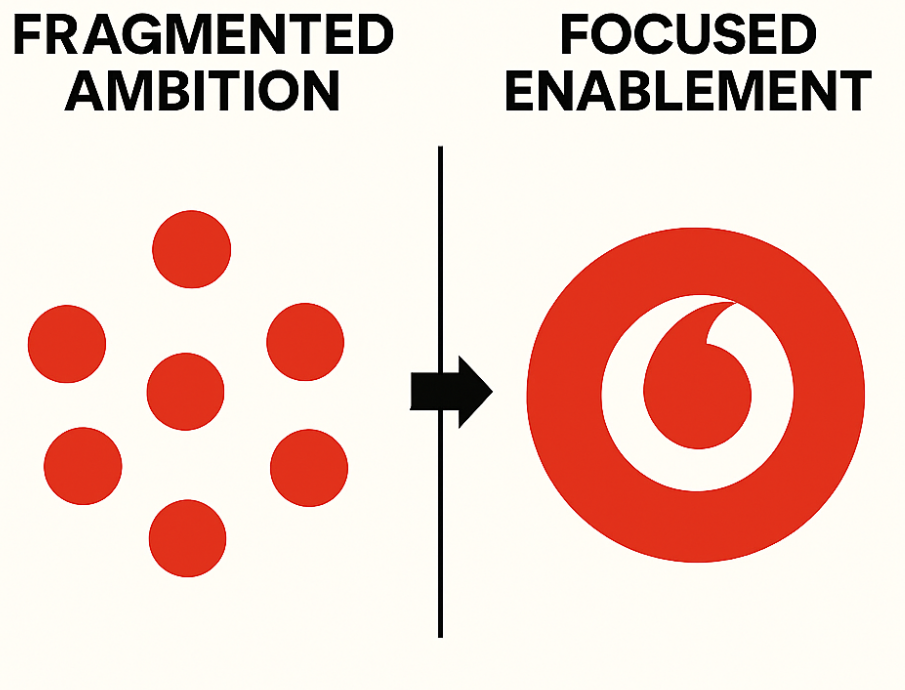
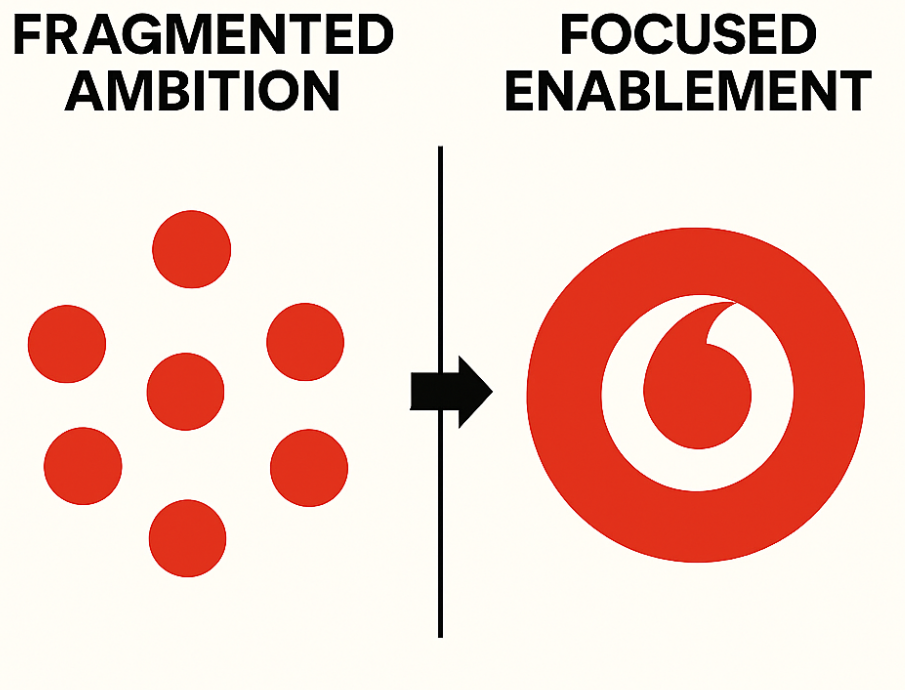
This wasn’t transformation by buzzword. It was a deliberate shift: from fragmented ambition to focused enablement. From chasing relevance to defining it.
So before your next pivot, ask yourself:
Are you scaling to signal growth—or to deliver it?
Are you building to impress—or to empower?
Because clarity isn’t just a strategy. It’s a signal. And the market knows the difference
Final FAQ: Cutting Through the Noise (Mark’s take)
1. Why didn’t Vodafone build a super app or chase platform dominance?
Because their strength wasn’t in aggregation—it was in orchestration. They chose to enable ecosystems, not own them.
2. Isn’t scale the fastest path to relevance?
Not always. Scale without strategic clarity creates noise. Vodafone proved that relevance comes from solving real problems, not just expanding footprint.
3. What’s the takeaway for other telcos or tech players?
Stop copying playbooks. Start clarifying your role. The market rewards those who build with purpose, not those who mimic for momentum.
This is a fascinating breakdown, but I’m left wondering—how much of Vodafone’s shift is truly replicable for smaller organizations or those outside the telco space? It’s one thing for a giant with global infrastructure to embrace modularity and ecosystem thinking, but for mid-sized companies the resources and partnerships just aren’t always there.
I also can’t help but question whether this “clarity over complexity” mantra is easier said than done. At what point does trimming back to your core strengths risk missing out on innovation or future growth opportunities? Sometimes chasing scale is what forces breakthroughs.
That said, I do agree the reminder that transformation is “deeply human” is spot on. I’ve seen too many digital initiatives stall because leadership leaned on tools instead of vision. Vodafone’s example feels like it highlights the balance—tech as enabler, but strategy as compass.
Curious—do you think other industries (like retail or healthcare) can actually adopt this same orchestration approach, or is this a lesson that only really applies to tech-driven giants like Vodafone?
Thanks for your comment @Jannette—I really appreciate the depth here, especially the tension you picked up between clarity and complexity. You’re right: Vodafone’s playbook isn’t a plug-and-play template for smaller orgs. But I do think the principles behind it—modularity, orchestration, and ecosystem leverage—can scale down if reframed as mindset rather than infrastructure.
On your point about “clarity over complexity,” this isn’t about trimming innovation—it’s about knowing which bets to double down on. Ironically, it’s often mid-sized players who benefit most from that discipline, because they can’t afford to chase every shiny object. Focus becomes a force multiplier. The business landscape is littered with former champions overtaken by leaner, more focused rivals.
And yes, the human layer is non-negotiable. Strategy without vision stalls. Teams without trust fail. Vodafone’s shift works because it re-centered around purpose—not just platforms.
As for other domains like retail or healthcare—absolutely. The orchestration might look different, but the need to align tech, teams, and trust is universal. I’ve spent a lot of time in Telco, but I’m keen to explore how this plays out across other sectors.
MarkA
This was such an insightful take, thank you for sharing it. A few questions came to mind while reading:
Do you think Vodafone’s “ecosystem thinking” approach is something smaller companies can realistically adopt, or is it only viable at enterprise scale?
How do you see leaders balancing the pressure for quick wins with the deeper clarity and conviction you mentioned?
In your view, what’s the biggest pitfall organizations face when they try to mimic transformations like Vodafone’s instead of tailoring their own?
Curious to hear your thoughts!
Thanks @Kris—I appreciate your comment. Some great questions here that get to the heart of strategic transformation.
On ecosystem thinking: while Vodafone’s scale gives it leverage, the mindset itself isn’t exclusive to ‘enterprise’. Smaller companies can absolutely adopt ecosystem principles—especially when they focus on partnerships, modular offerings, and shared data value. It’s more about intentional design than pure size.
Balancing quick wins with clarity is a real leadership paradox, From my experience the best leaders create space for both—delivering visible progress while getting buy-in of teams in the longer-term narrative. That clarity becomes the ‘compass’ for decision making when the pressure mounts.
And yes, the mimicry trap is real. The biggest pitfall? Copying surface-level moves without understanding the underlying drivers. Transformation isn’t a template—it’s a tailored response to your business challenges, and takes into account your culture, and capability. There is no ‘copy & paste’ here.
Thanks again for your comment – I really appreciate your insight.
MarkA