
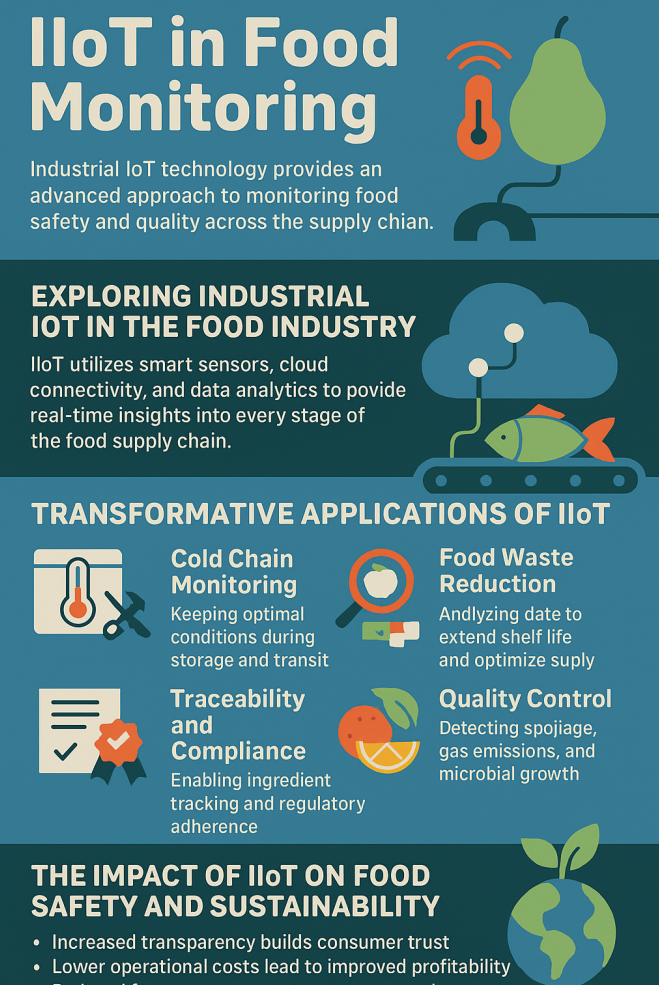
Food safety has become a hot topic in today’s globalized world. With supply chains stretching across continents, the journey from paddock to plate is riddled with complexities and potential pitfalls. Factors like contamination risks, freshness loss, and adherence to stringent international regulations present significant challenges.
Industrial IoT steps in as a game-changer, offering a smart upgrade to traditional food monitoring practices. Unlike conventional methods, IIoT integrates advanced technologies like smart sensors and cloud connectivity to ensure precision and real-time responsiveness at every step of the supply chain.
Imagine a system where data flows in seamlessly from every point, providing insights that are not just timely, but actionable. That’s the power of IIoT. It facilitates continuous monitoring and instant alerting, ensuring issues can be addressed before they escalate into critical problems.
With the help of IIoT, food producers can maintain rigorous quality standards while minimizing waste and maximizing efficiency. This tech-forward approach doesn’t just promise enhanced safety and compliance—it also opens the door to more sustainable business practices, ultimately reshaping the future of food monitoring.
Exploring Industrial IoT in the Food Industry
Industrial IoT (IIoT) is a powerful tool specifically designed to meet the complex demands of industries like food production. Unlike consumer IoT, which focuses on everyday convenience, IIoT applications are tailored for heavy-duty tasks, enhancing operational efficiency and precision on a larger scale.
At its core, IIoT in the food industry combines advanced smart sensors with cloud technologies and data-driven analytics. These sensors are strategically placed along the production line and throughout the distribution network. They gather crucial data points such as temperature, humidity, and movement, which are then processed using real-time analytics.
This setup enables a comprehensive view of the entire food pipeline. From monitoring the ripening of fruits in orchards to ensuring dairy products are kept at perfect temperatures during transport, IIoT provides vital insights at each stage. The integration of cloud systems means these insights are instantly accessible to stakeholders who can make informed decisions quickly.
Moreover, the adoption of IIoT paves the way for greater automation and scalability. It allows facilities to expand operations while maintaining consistent quality control. By leveraging these technologies, companies can stay ahead in the competitive food market, delivering fresher, safer products to consumers with unparalleled precision.
Transformative Applications of IIoT in Food Monitoring
IIoT plays a pivotal role in transforming how food safety and quality are managed. One standout application is in cold chain monitoring. With real-time temperature and humidity tracking, food transportation and storage are vastly improved. If conditions inch beyond safe limits, immediate alerts prevent spoilage and ensure nothing goes to waste.
Then there’s predictive maintenance. By keeping an eye on the health of machinery like mixers and refrigeration units, IIoT helps avert breakdowns. This means avoiding downtime or, worse, contamination risks due to equipment failures. Regular monitoring brings peace of mind, knowing the equipment is running smoothly and efficiently.
Traceability and compliance are other areas where IIoT makes a significant impact. Using blockchain-enabled systems, each ingredient can be tracked from its source to the store shelf. This transparency makes it easier and faster to manage food recalls, bolstering safety standards and ensuring compliance with regulations.
Did You Know?
Over 30% of food is lost or wasted globally each year — smart monitoring via IIoT could reduce this significantly by pinpointing inefficiencies early.
(Source: FAO – Food and Agriculture Organization of the UN)
Quality control and spoilage detection have also been revolutionized by sensors and AI-powered systems. By detecting gas emissions or microbial growth, these tools act as early-warning systems for potential quality issues in fresh produce. Additionally, AI-driven sorting systems enhance visual inspections, ensuring only the best products reach consumers.
IIoT is also a key player in food waste reduction. By analyzing data and pinpointing spoilage or bottleneck areas within supply chains, producers can adjust operations to extend shelf life and improve demand forecasting. These adjustments lead to both economic and environmental benefits, making IIoT indispensable in modern food systems.
The Impact of IIoT on Food Safety and Sustainability
Industrial IoT isn’t just changing the way food is monitored—it’s creating profound impacts on safety and sustainability. Transparency is a significant benefit, boosting consumer trust by showing exactly where their food comes from and how it’s handled along the way. This clear visibility builds a stronger connection between producers and consumers, establishing a trust that’s crucial in today’s market.
Real-time data isn’t just convenient — it’s critical for safe and sustainable food systems.
Operational costs also see a drop thanks to IIoT. With automated systems in place for real-time monitoring, companies can quickly address issues, reducing waste and the potential costs of recalls. This not only saves money but also enhances a company’s reputation by ensuring consistent delivery of safe, high-quality products.
Then there’s the environmental angle. By reducing food waste across the supply chain, IIoT contributes to a significant decrease in the carbon footprint. These improvements support broader sustainability goals, aligning food production practices with global efforts to address environmental challenges.
Embracing IIoT isn’t just a smart business decision—it’s essential for staying competitive in a fast-paced, quality-driven market. As technology continues to evolve, those in the food industry equipped with these innovative tools are well-positioned for future success, driving forward with smarter, safer, and more efficient food systems.
Explore More:
1. Milkvilla: IoT-Enabled Milk Delivery in India
Milkvilla, a startup based in Bihar, India, has revolutionized milk delivery by integrating IoT technology. They utilize Bluetooth-enabled, app-controlled milk dispensers mounted on autorickshaws to deliver chilled, desi cow milk directly into customers’ containers, eliminating the need for plastic packaging. The system ensures freshness by maintaining optimal temperatures and allows customers to manage subscriptions and payments through a mobile app. This approach not only enhances quality control but also promotes sustainability by reducing plastic waste.
2. Foyle Food Group: Energy Management with IoT Sensors
Foyle Food Group adopted EpiSensor’s IoT technology to monitor electricity usage, gas intensity, water consumption, and temperature across their facilities. The integration of IoT meters and sensors allowed for real-time data collection and analysis, leading to informed decision-making and enhanced energy efficiency. This implementation not only reduced operational costs but also supported the company’s sustainability goals.
3. Everactive: Steam Trap Monitoring in Food & Beverage Manufacturing
Everactive implemented an IIoT solution in a multi-million dollar food and beverage factory to monitor steam traps remotely. This wireless, batteryless system provided real-time data on equipment performance, enabling predictive maintenance and reducing energy costs. By preventing equipment failures and optimizing operations, the factory achieved significant cost savings and improved efficiency. Everactive Steam Trap Monitoring Case Study – Food & Beverage (May 2020)
The integration of Industrial IoT in food monitoring raises some interesting considerations about data reliability and long-term scalability. How do these systems handle the variability of real-world agricultural environments, especially in regions with limited connectivity? I’m also curious about how smaller farms can adopt such technology without significant upfront investment and are there scalable solutions in place?
Thank you Slavisa for raising such a thoughtful set of questions — they touch on the very real challenges of implementing IIoT in diverse, often unpredictable agricultural settings.
You’re absolutely right that data reliability in real-world environments is a critical concern. Fortunately, many modern IIoT systems are designed with robust, edge-computing capabilities, which means that sensors can process and store data locally, even if connectivity is temporarily lost. Once the connection is restored, the data is automatically synchronized. This makes it possible to maintain continuity even in areas with patchy or intermittent network access — a key feature for rural or remote regions. We also have many low cost ‘build your own network’ options – Like LoRaWAN.
As for scalability and adoption among smaller farms, there’s been growing momentum around modular, subscription-based models that significantly reduce upfront costs. Some providers now offer “as-a-service” solutions where farmers pay for insights rather than investing in the full hardware/software stack up front. Also, initiatives led by agri-tech startups and cooperative programs are beginning to bundle IIoT with government-backed subsidies or rural development grants — making it more accessible for smallholders.
In short, while challenges like connectivity and cost are very real, the ecosystem is evolving rapidly with more adaptive, affordable, and scalable solutions entering the market. It’s an exciting time, especially as these tools become more democratized and inclusive across the agricultural spectrum.
Thanks again for your question — it’s discussions like this that help push the conversation (and the tech) forward!
Thank you for this enlightening post on the role of Industrial IoT in food monitoring.
In our community, where farming is the primary occupation, understanding how technology can enhance the journey of produce from farm to fork is incredibly valuable. Your insights addressed many questions I had about the transportation and monitoring of farm products, especially concerning maintaining freshness and ensuring safety standards during transit.
I’m curious, how accessible are these IIoT solutions for small-scale farmers, particularly in rural areas with limited technological infrastructure? Also, are there initiatives or programs aimed at supporting farmers in adopting these technologies to improve their operations?
It’s encouraging to see how technology is transforming agriculture, and I appreciate you shedding light on these advancements.
Thank you so much for your kind words and thoughtful comment — I appreciate you taking the time to share your perspective, especially coming from a farming community where these technologies can make a real difference.
Your question about accessibility is incredibly important. During the early adoption of IoT solutions were too expensive for small scale farmers. However, while many IIoT solutions have traditionally been more common in large-scale operations, we’re starting to see more affordable, modular tools designed specifically for small-scale and rural farmers. Low-power sensors, mobile-based monitoring apps, and solar-powered devices are becoming more available — and they don’t necessarily require high-end infrastructure to operate effectively.
As for support programs, yes — there are several global and regional initiatives aimed at bridging the digital divide in agriculture. For example, programs like FAO’s e-Agriculture, USAID’s Feed the Future, and various government-funded smart farming grants work to bring IIoT tools into smaller or underserved communities. In some areas, ag-tech cooperatives or startups also partner with local producers to offer shared access to technologies or training on how to use them efficiently.
At the heart of it, the goal is to empower all farmers, not just the large ones, with better tools to monitor, protect, and improve their yields — and it’s inspiring to hear that this conversation is resonating where it matters most.
Thanks again for joining the dialogue — if you’re interested, I’d be happy to point to a few specific case studies or toolkits that might be relevant!