

Smart metering and service-based models like MaaS and DaaS offer solutions to Australia’s urban water challenges. Learn how in this strategic series.
Australia’s urban water sector is facing a reckoning. A recent government report warns that without systemic change, supply shortfalls and infrastructure strain will become the new normal. In previous post, we explored the operational imperatives of smart water. Now, we turn to the business models that can unlock their full potential.
Climate change isn’t pulling its punches. We’re dealing with more frequent droughts and unpredictable rain patterns. This isn’t just dreary news to skim over; the variability in weather is a massive wake-up call. It demands smarter measurement and management of our water resources if we want to stave off scarcity and secure a stable water future.
Add to that a growing population with growing water needs, and the pressure mounts. The old ways of managing supply simply won’t cut it.
Finances are another crunch point. Many councils and utilities find themselves in a bind with tight budgets. It’s no longer feasible to solely rely on hefty infrastructure project fund injections to solve our water woes. Instead, there’s an emerging need for creative financial approaches that maximize impact without breaking the bank.
Let’s not sideline the consumers here either. There’s a palpable resistance to increased rates among residents, who nevertheless expect more bang for their buck. The public’s growing demand for better infrastructure and outcomes, all while minimizing disruption to their daily lives, puts another layer of pressure on traditional models. This tension between rising expectations and constrained resources demands not just better tech—but smarter strategy.
Operationally, there’s no room for old-school complacency. Leak detection, predictive maintenance, and real-time data collection aren’t just high-tech goodies—they’re essential. These tools help in making immediate, informed decisions, ensuring the entire system runs smoothly and efficiently. Adapting to these operational needs sets the foundation for sustainable urban water management.
Taken together, these factors create a climate of urgency and opportunity in Australia’s urban water sector. It’s a complex puzzle, but with challenges come the chance to innovate and set the stage for a more sustainable future. As we continue through the ‘Smart Water, Smarter Models’ series, we’ll keep digging into these issues, offering insights and solutions for making the most of this critical juncture.
Toward Transformation: Reimagining Business Models for the Future
While the need for innovative technology in water management is clear, it’s not the whole story. The real shift requires a transformation of the business models that underpin how we deliver water services. Historically, the approach has revolved around full ownership, leading to high capital expenditures and dragging down the pace of innovation with slow-moving, traditional infrastructure projects.
But the structural constraints of these legacy models can no longer keep up with today’s pressures—especially when fiscal leeway is shrinking and public tolerance for rate hikes is wearing thin. As the Productivity Commission warns, “There is increasing community resistance to price increases, even when they are necessary to maintain service levels and invest in infrastructure.” That resistance puts traditional models under strain and makes innovation not just desirable, but essential.
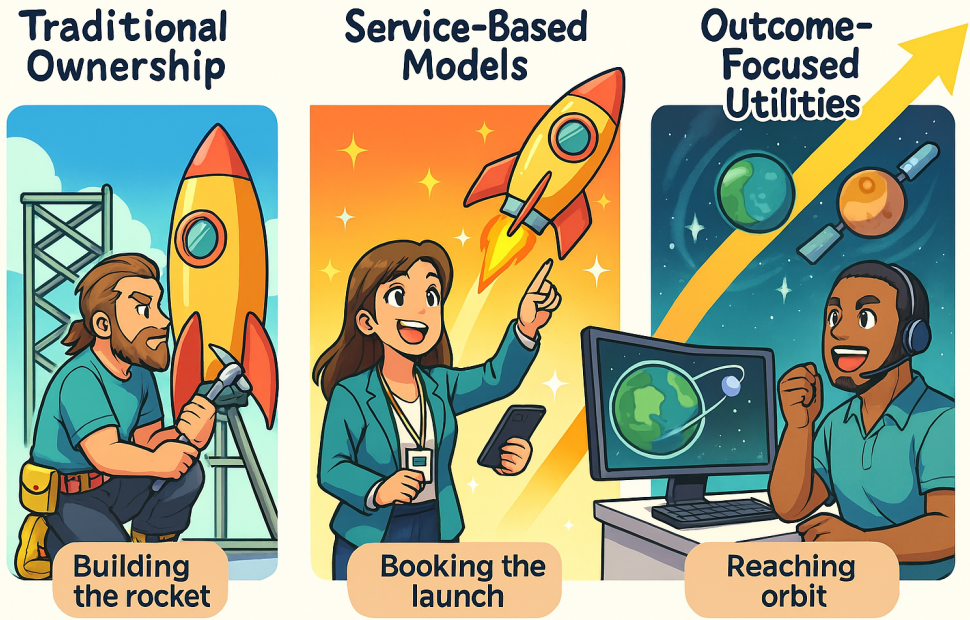
Enter service-based models—think MaaS (Metering as a Service) and DaaS (Data as a Service). These frameworks represent a shift from concrete to cloud—from owning every bolt and byte to accessing scalable, expert-led services. Crucially, they allow utilities to sidestep the need to become tech experts overnight. Consider this: one major utility spent several years preparing its smart water rollout and has only deployed a fraction of its total meter fleet. Meanwhile, service-led deployments elsewhere are achieving rollout rates exceeding ten thousand per month.
That’s the difference between building the rocket and booking your seat on one.
This change isn’t just about technology; it’s a strategic rethinking of how to best deliver and manage services. It’s about unlocking speed, flexibility, and outcomes—without the drag of legacy ownership.
These service-oriented models open the door for utilities to address customer needs more flexibly and effectively. They minimize upfront capital investments and shift the focus from simply owning resources to optimizing their use. For example, adopting a DaaS model allows access to cutting-edge data analytics without shouldering the full costs of developing in-house capabilities.
For utilities and councils, it’s crucial to recognize this pivot isn’t merely technical. It’s an invitation to innovate, moving away from the static ownership model towards a more dynamic, service-focused model. This evolution supports quicker adoption of new technologies and practices, allowing for a more responsive and efficient service delivery.
As we continue this series, we’ll explore how these business model innovations can lead to powerful outcomes. With the right balance of technology and strategy, urban water management can transform to not only meet but exceed the expectations of today’s environment.
What’s Next in the Smart Water Series
Today’s challenges in the urban water sector highlight a crucial moment in time. With both problems and opportunities at our doorstep, it’s crucial we equip ourselves with new ways of thinking about water management, and this series aims to do just that. Building on the themes we’ve explored, our upcoming article, ‘From Ownership to Outcomes – MaaS and DaaS Explained,’ will unpack these modern service-based models in more detail.
By transitioning to models like MaaS and DaaS, utilities can address existing challenges head-on, simplifying the integration of emerging technologies and techniques without the accompanying burdensome costs. This shift is about moving past the limits of owning infrastructure toward maximizing outcomes and efficiencies with innovative service options.
The next pieces in this series will guide you through how to harness these models effectively. We’ll break down complexities, examine real-world applications, and spotlight success stories that illuminate the path forward for water utilities and councils.
As we delve further into this series, you’ll see that smart water management goes far beyond applying technology—it’s about a mindset change in how we approach sustainability and service delivery. Expect insights that will help guide practical decisions in redesigning how we meet water demands now and into the future.
Stay engaged with ‘Smart Water, Smarter Models’ for continual exploration into the strategies shaping a resilient, sustainable urban water future. Smart Water, Smarter Models is just getting started—and the possibilities ahead are anything but dry.
Hello Mark!
I really enjoyed this article— “smart water” is one of those topics that feels distant until you see how deeply it impacts daily life and communities. Your discussion of how climate pressures, infrastructure costs, and consumer expectations all intersect made me stop and think about how vital innovation really is.
From my perspective as a stay-at-home mom, I often take water use for granted—turning on taps, filling pots, watering plants—all without much thought. Reading this made me wonder: what if our household gadgets were smarter about conserving water and informing us of leaks or usage in real time? I’d be curious to see a home version of some of these technologies.
A few thoughts I’d love your take on:
—Do you see smart water models (MaaS, DaaS) ever trickling down to residential users, or will they remain primarily for utility-scale implementation?
—When it comes to cost, how realistic is it for towns with tight budgets to adopt these models without burdening everyday consumers?
Thanks for shining light on such an important issue and making the case that “smart water” isn’t just a buzzword—it’s becoming essential.
Angela M 🙂
Thanks Angela – I am glad you enjoyed this one.
We are seeing more and more ‘smart’ devices coming to market to assist with water scarcity. We are also seeing water utilities invest in some great platforms to allow consumers to see consumption, compare themselves to their peers and make positive steps to reduce usage. Check out gamifying water consumption – its a great example of what is out there.
To your questions:
—Do you see smart water models (MaaS, DaaS) ever trickling down to residential users, or will they remain primarily for utility-scale implementation? These relate more to the utility level model than for the consumer – sort of like leasing a car instead of buying in at the enterprise level.
—When it comes to cost, how realistic is it for towns with tight budgets to adopt these models without burdening everyday consumers? From my experience the ‘magic’ here is in the continuous monitoring – this identifies leaks (that currently take up to 15% of water) – and early detection of failures (which are very expensive – think water spout on a main road). If a utility sets this up correctly there should be minimal impact tot he consumer hip pocket.
Thanks again for your comment.
MarkA
Another important thing that stood out for me was MaaS and DaaS are the key enablers to enable Decision-ready data streams, which would not only help understand “what happened” but also “why it happened” and “what to do next”.
I call this layer “DecisionData-as-a-Service” (DdaaS).
100% @Pradeep. Your comment prompts me to seek out a better title than MaaS/DaaS as you suggest – along the line of Decision Data/Outcome as a Service…
Appreciate the comment!
MarkA
Really interesting read, Mark.
The point that stood out to me was the shift from ownership-heavy models to service-based ones like MaaS and DaaS. It makes sense that utilities can move faster and avoid the drag of legacy infrastructure by “booking the seat on the rocket” instead of trying to build it themselves.
That said, I wonder how communities will feel about the trade-offs. Especially since people are already resistant to rate increases. Do you think customers will be more open to service-based models if they see tangible improvements like fewer leaks, lower bills, or better service reliability? Or will the idea of outsourcing water services raise new concerns around control and accountability?
John
Thanks John – I appreciate you taking the time to comment. Your are correct in terms of the consumers – they don’t want to pay any more for their service. The big savings for the utility come with leak detection (accounts for 10-15% pf water consumer) as well as preventative maintenance of the network (finding low pressure, faulty main pipes etc). If the MaaS/DaaS provider knows what they are doing they should achieve a business case that sees the savings covering the change of operating model costs.
MarkA