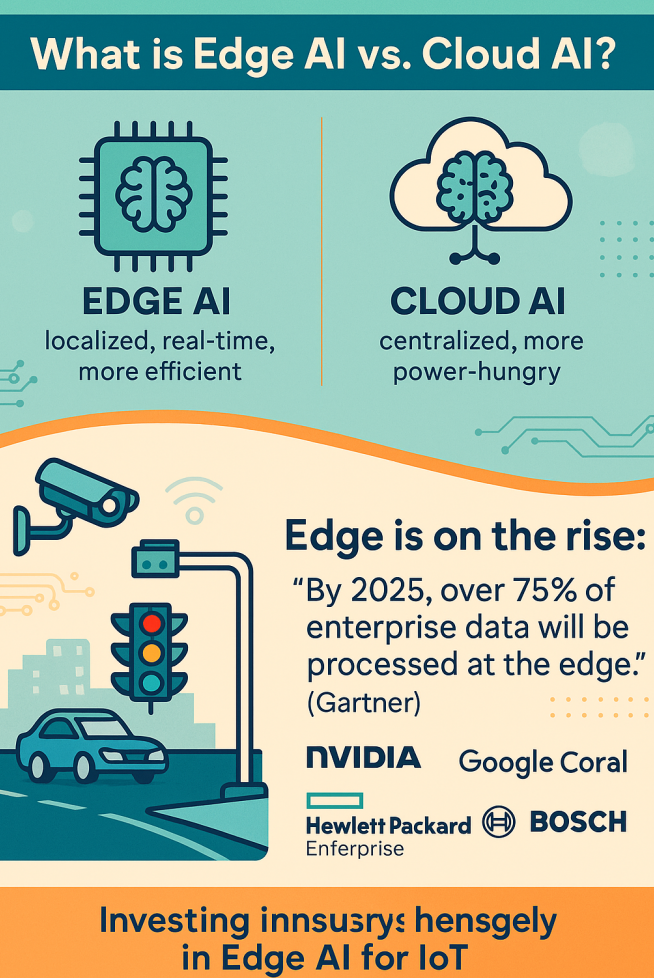
As IoT continues to evolve, the demand for real-time, intelligent processing is rising. That’s where Edge AI steps in—bringing AI capabilities directly to devices at the edge of networks. It’s a shift that’s transforming industries by delivering faster insights, better automation, and greater privacy. What is Edge AI vs. Cloud AI?
- Cloud AI (centralized, more power-hungry)
- Edge AI (localized, real-time, more efficient)
Edge AI technology is making waves, especially in IoT ecosystems. By processing data directly on devices like sensors and cameras, Edge AI reduces latency and boosts response times. This means quicker, more efficient decision-making right where it’s needed.
Pairing Edge AI with IoT leads to incredible enhancements in decision-making and data processing. Picture smart traffic lights in a city that adjust in real-time based on vehicle density, improving traffic flow and reducing congestion. That’s what synergy looks like.
We’re seeing Edge AI in action across various fields. In smart homes, it manages energy use more effectively, cutting costs and consumption. In industrial settings, Edge AI optimizes machinery performance and predicts maintenance needs ahead of time, minimizing downtime. Edge is on the rise:
- “By 2025, over 75% of enterprise data will be processed at the edge.” (Gartner)
- NVIDIA, Google Coral, HPE, and Bosch —are investing heavily in Edge AI for IoT.
Despite its advantages, Edge AI in IoT faces hurdles like data privacy and scaling challenges. Many folks worry about sensitive information on Edge devices. Addressing these through robust security measures and scalable solutions is key to widespread adoption.
Looking ahead, the future of Edge AI in IoT feels promising. Innovations will likely focus on making devices smarter and even less dependent on cloud servers. This evolution could revolutionize industries ranging from healthcare to transport, making systems more autonomous and efficient.
Optimizing IoT Systems Through Intelligent Edge AI Solutions
Deploying Edge AI in IoT frameworks requires careful planning. Not every situation benefits from on-device processing, so analyze the context and determine where it’s most effective. Sometimes, central cloud computing remains the best option, depending on the complexity of the task.
Balancing cost and performance is crucial. Edge AI can reduce costs by decreasing data transmission needs and using less bandwidth. Yet, investing in powerful Edge devices might be expensive initially. Consider long-term savings and efficiencies to determine the best path forward.
Security stands at the forefront when dealing with data at the Edge. Implement measures to protect this information. Encryption and secure firmware updates are essential to prevent breaches and maintain user trust. New security approaches are coming to market to tackle this challenge:
- TPMs (Trusted Platform Modules)
- AI model updates over-the-air (OTA)
- Zero Trust architecture in edge security
Customizing Edge AI solutions is necessary for meeting specific industry demands. A one-size-fits-all approach won’t work here. For instance, retail might focus on real-time inventory management, while agriculture could benefit from immediate weather analysis and equipment control.
Evaluating the impact of Edge AI on IoT setups involves tracking key success metrics. Look beyond traditional measures and include both operational efficiencies and user satisfaction. Getting these insights ensures that the implemented solutions act in the best interest of the organization and its clients.
Edge AI and IoT together represent the next phase of smart system design—local, agile, and intelligent. As organizations invest in this synergy, the payoff will be more responsive systems, reduced costs, and ultimately, smarter decisions made exactly where and when they matter most.
Technology is certainly moving a lot faster and I feel like I just can’t keep up with all the new developments. That’s why it is handy to have website like this to visit to catch up on the latest AI fads. This is the first I have seen with the difference between cloud and edge AI explained.
As an entrepreneur working on my own, I am sure I wouldn’t need all of these solutions. What type of AI would be the best solution for someone working on their own building a website?
Thanks h for your thoughtful comment— I totally understand where you’re coming from! Tech is evolving fast, and it can be a lot to keep up with. That’s why I created this site—to help make the latest developments in AI and IoT a little more approachable.
Great question about what’s most useful for solo entrepreneurs building a website. In your case, cloud-based AI solutions are usually the best place to start. They’re easier to implement, require less hardware investment, and often come built into tools probably already use —like AI-powered SEO plugins, chatbots, content assistants, or analytics platforms (e.g., Google Analytics with predictive insights).
Edge AI tends to shine more in environments where you need real-time responses on physical devices (like sensors, cameras, or smart home tech), so it might be more relevant down the road if your business expands into hardware or IoT products.
Let me know what kind of site you’re building—I’d be happy to suggest some lightweight AI tools that could help!