
AI and IoT are two buzzwords that have been transforming how we interact with technology. But what happens when you bring them together? AI, with its capability to learn and adapt, and IoT, offering connectivity between devices, create a powerful duo that’s reshaping smart homes.
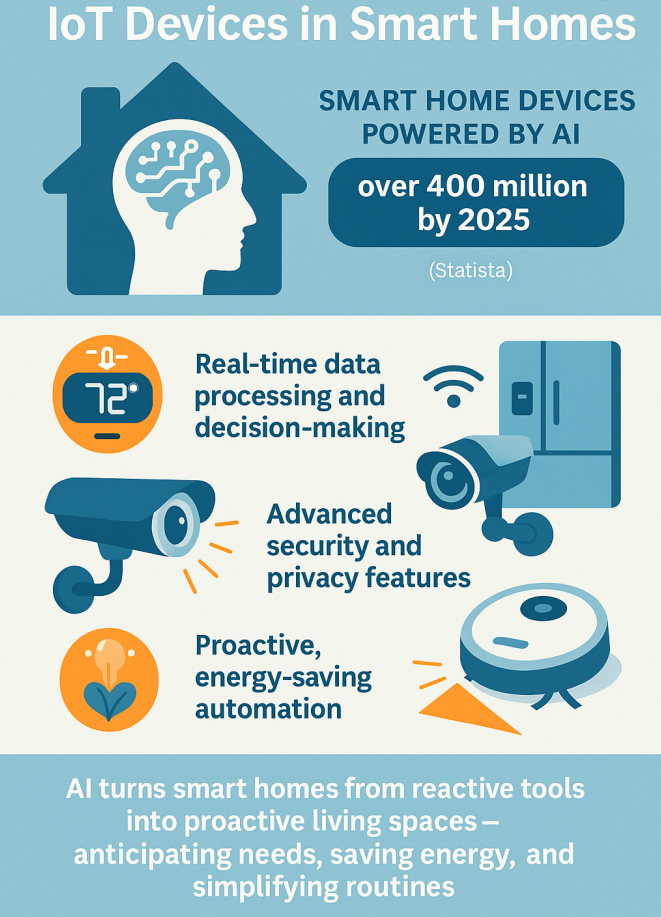
In today’s digital world, the convergence of Artificial Intelligence (AI) and the Internet of Things (IoT) is reshaping homes by transforming passive devices into active, learning systems. By 2025, over 400 million smart home devices will be powered by AI, transforming passive environments into active, learning systems. (Source: Statista)
With AI, IoT devices aren’t just connected; they become intelligent. This means they can process data in real-time, learn from habits, and make decisions without needing constant human input. Think of a smart thermostat adjusting temperatures based on your past behavior or a security system that understands the difference between usual and suspicious activity.
Incorporating AI into IoT devices isn’t just theoretical; it’s happening around us. We’re seeing smart lighting systems adjusting based on daylight, AI-driven vacuums like iRobot’s Roomba j7+ learning floor layouts and avoiding obstacles, and refrigerators tracking food expiry dates. These examples highlight how AI turns smart homes from reactive tools into proactive living spaces—anticipating needs, saving energy, and simplifying daily routines.
Of course, bringing AI and IoT together isn’t without its hurdles. There’s the technical complexity of integrating these technologies and the ongoing concern about data security. Leading manufacturers are now implementing on-device AI processing, also known as edge AI, which keeps personal data local to reduce risk and latency. This means devices like cameras and voice assistants no longer need to send sensitive data to the cloud for analysis. These advances, combined with transparent data usage policies, are helping to protect user privacy and build trust in smart systems.
However, the benefits—such as personalized experiences and increased efficiency—are driving continued innovation and adoption in smart homes. By understanding these challenges, we can better prepare for the digital homes of the future.
Enhancing Everyday Life with AI-Powered Smart Devices
Think about the seamless nature of having appliances and systems that intuitively cater to your daily needs. AI enhances this experience by giving smart devices an edge. Gadgets like smart thermostats not just learn your preferences but predict future settings for comfort and energy efficiency.
Voice assistants are a prime example. They’re more than just tools for playing music or setting reminders. With AI, they become central hubs, managing everything from lighting to security systems with simple voice commands. As they grow more sophisticated, they facilitate more intuitive and accessible home automation.
AI doesn’t just simplify; it protects. Smart home security systems get a significant boost from AI, learning to identify potential threats by distinguishing between regular movements and unusual patterns. Similarly, AI-fueled energy management systems analyze usage patterns to recommend ways to cut back on unnecessary energy consumption, promoting savings and efficiency.
AI’s influence extends to refining the user experience. It’s not just about having tech-savvy devices at home; it’s about ensuring these devices cater to the distinct needs of every family member. Smart homes that prioritize user experience through AI-driven personalization can adjust settings based on individual user preferences and habits, creating spaces that feel tailor-crafted for each person.
The Future of AI in IoT Devices and Smart Homes
Peering into the not-so-distant future, AI’s role in enhancing IoT devices suggests some exciting advancements for smart homes. New AI technologies are emerging, aimed at perfecting the seamless integration of devices, predicting user needs with remarkable accuracy, and offering even more intuitive solutions.
Smart home customization will take a big leap forward as AI starts to cater to individual habits and preferences, making the home environment more comfortable and efficient. Imagine personalized lighting ambience based on mood detection or AI suggesting maintenance tasks before a breakdown occurs.
However, as AI continues to grow its presence, ethical considerations regarding data privacy can’t be ignored. Ensuring that personal data remains confidential despite increasing connectivity is crucial. This priority is driving development towards transparent data usage policies and robust security measures.
The synergy between AI and IoT promises to push boundaries, making homes not just tech-savvy but genuinely adaptive to activities and preferences. Striking the right balance between convenience, security, and sustainability will define the next chapter in smart home evolution.
As AI becomes more intuitive and IoT devices more ubiquitous, smart homes will evolve from programmable gadgets to empathetic environments—learning, anticipating, and adapting to our lives in truly meaningful ways.
This was a fascinating read! I love how clearly the article explains the ways AI is making smart homes more intuitive—like learning our habits, improving energy use, and even boosting home security. It’s incredible how far we’ve come from basic automation to predictive, responsive systems. I’m curious though: how do you see privacy evolving as AI gets more involved in our daily routines? And are there affordable smart home devices using AI that are great for beginners? Thanks for the insight!
Hi Elena and thank you for your kind words. AI and IoT are 2 things I am always thinking about, so I’m really glad you enjoyed the article and found it clear and interesting! It’s amazing, isn’t it, to see how AI has taken smart homes from simple automation to truly responsive, personalized systems.
You raise an excellent point about privacy. As AI gets more deeply woven into our daily lives, responsible data handling is crucial. Many manufacturers are now shifting to on-device AI processing (also known as Edge AI), which keeps data local rather than sending everything to the cloud. This helps reduce risks and build trust. Plus, clearer data policies and user controls are becoming standard, so homeowners have more say over what’s shared. This later point is critical for me – ultimately the data (in my opinion) belongs to us, not companies.
For beginners wanting to dip a toe into AI-powered smart homes without breaking the bank, there are some great affordable things that you can try:
✅ Smart speakers and displays (like Google Nest or Amazon Echo) — cheap, and a great central hub.
✅ Budget-friendly smart plugs and bulbs — simple to set up and you can control them with voice or an app.
✅ Entry-level smart thermostats — some models learn your schedule and help save on energy bills.
These are great starter devices to experience the benefits of AI at home without a big upfront cost.
If you’d like, I can share a few brand suggestions or setup tips too — just let me know! Could be a topic for a follow on post. Thanks again for reading and for sparking such a thoughtful discussion. ????????✨
This article provides an insightful overview of how AI is transforming IoT devices within smart homes, highlighting the synergy between intelligent automation and daily convenience. The discussion on personalized experiences, energy efficiency, and predictive maintenance effectively illustrates the practical benefits for modern households. It’s impressive how the integration of AI not only enhances user experience but also contributes to a smarter, more sustainable lifestyle.
Thank you for your feedback! I’m really glad the article resonated with you. The synergy between AI and IoT really is changing the way we think about everyday living—from improving comfort and convenience to driving energy efficiency and sustainability.
It’s amazing to see how fast smart homes have moved beyond simple automation and into truly adaptive environments that learn and respond to our needs. As the technology continues to evolve, I think we’ll see even more significant innovations that balance personalization with responsible energy use and data privacy.
Are there any specific smart home technologies you’ve used or are excited to try? I’d love to hear your perspective!